Showing posts with label Mushrooms. Show all posts

Tuesday, January 12, 2021

Classic Beef Stew

My first cooking class of 2021 was called Classic Comfort Food.  Even though the phrase "comfort food" is a bit of a cliché, I am unapologetic about the title.  I think it is useful in describing what we all seem to need at the moment.  It is meant to describe food that transports us to tables and moments past when simple, familiar food—prepared by someone who loved us—had the ability to momentarily hold our worries at bay.  I could use some of that right now.  Furthermore, for me, these foods also remind me of people that I love—and meals shared with them.  Since I’m eating all of my meals alone these days, I could use some of that too. 


The beef stew my mother made when I was growing up was delicious.  I was a picky eater…but I loved her stew.  The stew I make today is actually very similar to the one she made.  I have returned it to its French roots (with a bit more attention to technique…and added red wine, bacon and mushrooms), and I have omitted her final addition of peas.  But otherwise, the tender meat, carrots, and potatoes, suspended in a rustic “broth” –lightly thickened by virtue of the flour-dredged beef, the onions that have disintegrated from long cooking, and the starch released from the potatoes—is exactly like hers.  There are no tomatoes…or peppers…or other odd ingredients that I would have resented as a child—just a simple, straight forward, bowl of beefy goodness.  I always think of long ago family meals when I sit down to a bowl of that stew.

If you have never made beef stew, this one is a good place to start.
  It gives back loads of flavor for minimal effort...and is a perfect activity for a homebound Saturday or Sunday. As with all braises, it will take the better part of the afternoon to make.   But since most of that time is in the oven with nothing required of you (other than the occasional peek under the lid), it counts as easy in my book.  If you aren’t familiar with the hows, whys and processes of a braise, check out my basics post from a few years ago before getting started.

One important thing to note: when you’re shopping, make sure you purchase beef chuck or boneless short rib meat—not the “stew meat” sold at most butcher counters.
  Generic stew meat is usually a mystery conglomeration of beef trim that serves as a way for the butcher to make money from what would otherwise go in the trash.  To prepare a good stew, you need specific tough, sinewy cuts from around the joints and well-used muscles of the animal.  “Stew meat” may or may not contain these cuts. 

Furthermore, the pieces of meat you use for your stew need to be on the large side—certainly larger than the nubbins in the stew meat bin.
  Small pieces of meat will disintegrate into the broth.  The large pieces will look more attractive and be easier to serve.  It is an easy thing to just cut up a chuck roast or some boneless beef short ribs yourself when you get home.  Cut the meat into 1 1/2- to 2-inch cubes.  These pieces will seem large…but they will shrink as they cook.  And you needn’t worry that the large pieces will be difficult to eat from a bowl:  when cooked properly, the meat is tender enough to be “cut” into bite-sized pieces with a spoon.   Another bonus in cutting the meat yourself:  you can be as fastidious as you like in removing the fat.  I generally only remove obvious, large knobs since most of the fat will dissolve and add flavor and moisture to the stew.  Any excess can be blotted off or skimmed away from the finished stew. 


I had hoped that this year would be less traumatic than last.  So far the year isn’t very promising.  One of the things I have control over is how I feed myself.  So, I continue to cook….every day.  I highly recommend it.  Occasionally preparing and eating a bowl of stew…or some other delicious and simple food that reminds me of people I wish I could be with and better days…gives me a measure of hope that things will one day be better again. 


Classic French-style Beef Stew

2 1/2 to 3 lbs. boneless beef short ribs or chuck, cut into 1 1/2-inch pieces
Salt & freshly ground pepper
4 oz. thick-sliced bacon, cut crosswise into 1/2-inch strips
1/2 c. all-purpose flour
2 onions, (about 1 lb.) cut in a 1/2-inch dice
2 large cloves garlic, minced
salt and pepper, to taste
3/4 c. dry red wine
3 to 4 c. beef or chicken stock—if using canned, use low-salt
2 or 3 sprigs thyme
1 lb. carrots, peeled and cut crosswise on a 1/2-inch short diagonal
1 lb. Yukon potatoes, peeled and cut into 1-inch chunks
8 oz. mushrooms, cleaned and halved (quartered, if large)
1/4 c. minced flat-leaf parsley


The day before you plan to prepare the stew, season the meat generously with salt.  I use 3/4 t. of kosher salt per pound of meat (so about 2 t.).  Wrap loosely and refrigerate overnight.

To prepare the stew: Render the bacon in a large stew pot or Dutch oven set over medium heat.
  When the bacon is crisp, remove it along with the fat, reserving each separately. 


While the bacon cooks, dredge the beef in the flour, shaking off the excess.  


Return enough of the bacon fat to the pan to coat the bottom of the pan and increase the heat to medium-high.  Brown the beef on all sides—it may be necessary to do this in batches so the pan isn’t over-crowded.  


Add more bacon fat as necessary.  Remove all the meat to a platter 


and add more bacon fat or olive oil to the pan.  Add the onions.  Regulate the heat as necessary to sweat the onions just until softened and beginning to take on a golden color (about 5 to 10 minutes).  


Add the garlic and continue to cook for a minute or so.  Add the wine and bring to a boil, scraping the bottom of the pan to release the caramelized meat and vegetable juices.  Reduce the wine by at least half. 


Return the meat to the pan and add enough broth to cover the meat.  


Add the thyme.  Bring to a boil.  Cover and transfer to a preheated 300° oven.  Bake for 2 hours, checking occasionally to make sure the stew is cooking at a bare simmer.  It should not boil hard…but it should maintain an active simmer.  Reduce the oven temperature if necessary.

After 2 hours, remove the stew from the oven.  If there is a lot of grease pooling on the surface, spoon it off, or blot with a paper towel.  


Add the potatoes and carrots, season with salt and pepper, cover and return to the oven until the meat and vegetables are fork tender (about 45 minutes to an hour more).


While the stew finishes cooking, sauté the mushrooms in some of the bacon fat (or olive oil or butter) until nicely browned; Season with salt and pepper and set aside.


When the vegetables are tender, carefully stir in the mushrooms and bacon.  Taste and correct the seasoning.  Remove the thyme sprigs and serve, sprinkled with minced parsley.  Serves 6
 

(Recipe adapted from The Kansas City Star November 11, 1992)

Variation

  • Classically, this French-style stew would be finished with glazed pearl onions in addition to the mushrooms and bacon.  To prepare the pearl onions, place 8 oz. of peeled pearl onions in a saucepan and cover them with water.  Add 1/2 T. of butter, a teaspoon of sugar and a pinch of salt and bring to a simmer.  Cover and cook until almost tender.  Uncover and increase the heat to high and boil until the liquid is reduced to a glaze; reduce the heat to medium and continue to cook until the glaze turns a golden brown, swirling the pan to coat the onions with the glaze.  Scatter the pearl onions over the stew with the mushrooms and bacon.  Or, for a more classic presentation, reheat the pearl onions, mushrooms and bacon separately and garnish each bowl of stew individually with them.
  • For a more American-style beef stew, omit the red wine, mushrooms and bacon.  Brown the meat in vegetable oil.  Add a cup of frozen peas to the stew during the last five minutes of cooking.


Monday, December 2, 2019

Savory Braided Loaf…Filled with Spinach, Mushrooms & Cambozola

One of the things I enjoy the most about my cooking classes is the fact that people feel free to ask questions.  Good questions make me think more carefully about almost every aspect of cooking (methods, flavors, ingredients, culture, etc.).  This serves to make me a better cook…and a better teacher…and often it gives me great ideas for new recipes.


During my last class—Cooking for Holiday House Guests—I demonstrated the recipe for a Jam and Cheese-filled Yeasted Coffee Braid.  Because I love sweet breakfast breads—for breakfast, brunch, coffee or a late night snack (basically all the time)—that’s what was filling my mind as I discussed the recipe.  Suddenly someone asked if they could use the dough and method for a savory filled braid.  My initial reaction was: of course not…this is a sweet dough.  But then it immediately dawned on me that of course you could make a savory bread…as long as you reduced the sugar in the dough just a bit (although, not too much…the dough actually isn’t that sweet).

Over the next few days I continued to think about all the possibilities of a savory braid.  Then the following week I decided to make one to serve as a snack for a gathering of friends.  I filled that first attempt with a garlic and herb flavored ricotta (in place of the sweetened cream cheese in the sweet version), prosciutto, sundried tomatoes, sautéed mushrooms and goat cheese  It tasted good, but I didn’t use nearly enough of the filling ingredients. 

My mistake was that I still had the requirements of the sweet braid in my head.  One of these requirements is to not use too much jam.  Besides the fact that too much jam filling oozes out all over the baking sheet, a generous amount of bread is what I expect in a breakfast pastry.  This isn’t the case with the savory version. I wouldn’t want to go on record as saying that you can’t have too much filling in the savory braid….but in this version, the filling is the star.  The bread is just a convenient and beautiful vehicle.


Since the recipe makes enough dough for two braids, I had the opportunity to make a second pass at getting the quantity of filling right.  Of course it would have made sense (from a recipe-testing, compare and contrast perspective) to just increase the quantity of all the filling ingredients that I had used the first time. But when I finally got around to making the second braid (one of the nice things about this dough is that it will keep for 3 or 4 days in the refrigerator) I was more interested in making dinner than testing a recipe.  In any case, I had some other ingredients in my pantry that I wanted to use and that I thought would make a nice filling…so I used those instead.  The second braid was delicious.  And the balance of dough to filling was perfect.

When I made the second braid, I still had half of the herbed ricotta left from when I made the first braid, so I went ahead and used it.  Not only does this cheese mixture taste good, it provides a nice base for the other fillings.  But I’m certain that you could use seasoned cream cheese or goat cheese…or maybe Boursin…or even a simple herbed sour cream.  I still had mushrooms, so I repeated the sautéed mushrooms too.  But for the second version I doubled the quantity. 


The biggest change I made for the second braid was that I added some cooked spinach.  And I think the spinach was the key to the success of the second braid.  Even when cooked to the point where the excess liquid has evaporated (which you must do to keep the loaf from being soggy and damp), greens are still inherently moist.  So not only do they add nice flavor, they keep the filling from seeming dry.  Other greens (kale, chard, beet greens, etc) would work too…as long as you cook them in the manner appropriate for your chosen green.  Kale, for example, will need to be blanched and squeezed dry before it is added to the pan of mushrooms.  And while it isn’t a leafy green, it occurred to me that cooked leeks would behave in a similar manner (and would be delicious!). 

I replaced the crumbled goat cheese with some sliced Cambozola (a German, Brie-style, triple cream blue cheese).  I’m very partial to the Cambozola…but it isn’t something I typically keep on hand.  I wouldn’t hesitate to substitute another flavorful melting cheese.  (But if you are shopping for the other ingredients, you should definitely pick up the Cambozola!)

Finally, if you decide to improvise with your savory fillings, I think it’s important to include ingredients that are strongly flavored.  In my braid, mushrooms and blue cheese fill the bill in this regard.  Cured meats (ham/prosciutto, cooked sausage and bacon) would be good.  Brined/salt preserved foods like olives or capers…or anchovies…would pack a nice flavorful punch.   Other strongly flavored items include pesto, tapenade, and sundried tomatoes.  I’m sure I’m forgetting some obvious possibilities…but you get the idea.    

I don’t know if the person who asked if the jam braid could be turned into a savory filled bread will see this post, but if he does, I would love to hear if he took a stab at it.  And of course I would also like to thank him for asking the question in the first place.  It was obviously a great source of inspiration.  I even think it’s possible that this version might make its way into a class someday….


Spinach, Mushroom & Cambozola Filled Braided Bread

1/4 c. (56 g.) lukewarm (105 to 115 degrees) water
2 1/4 t. active dry or instant yeast
1/2 c. (121 g.) sour cream
4 T. (56 g.) unsalted butter, sliced 1/4-inch thick and softened
1 large egg
3 c. (360 g.) unbleached all-purpose flour, divided
1 T. (12 g.) sugar
1 t. salt

1 c. (250g) whole milk ricotta
1/3 c. (30g) finely grated pecorino
1 fat clove garlic, smashed to a purée with a pinch of salt (or grated on a microplaner)
1 t. minced fresh rosemary
1 egg yolk (save the white for the egg wash)

2 to 4 T. olive oil
14 to 16 oz. crimini or white mushrooms, sliced
10 oz. baby spinach, large stems trimmed if necessary, leaves coarsely chopped
7 to 8 oz. Cambozola, sliced a scant 1/4-inch thick and torn into 1-inch pieces 

1 large egg white beaten until frothy with 1 T. cold water
3 to 4 T. sesame seeds

Place the water in a mixing bowl and scatter in the yeast.  Whisk or stir to dissolve.  Add the remaining ingredients in the order listed, adding only 340 grams of the flour and making sure the salt doesn’t touch the yeast-water mixture directly.  Mix and knead (by hand or mixer fitted with a dough hook) until you have a smooth, velvety dough.  The dough will be very dry at first; resist the urge to add more liquid. It'll come together and smooth out as you knead.  Once the dry ingredients are absorbed (and this only takes a minute or two) the dough may begin to stick.  Use small increments of the extra 20 grams of flour…and the help of your bench scraper…to keep the dough from sticking.  It is unlikely that you will need all of the reserved flour.

Place the dough in a lightly buttered bowl or other container, cover with plastic wrap and let rise until doubled in bulk (about an hour).  Deflate the dough, cover with plastic wrap and place in the refrigerator overnight (and up to three or four days).  It may or may not look risen when you pull it out to use it.  That's OK.

When you are ready to bake, make the filling: Combine the ricotta, pecorino, garlic, rosemary, and egg yolk.  Set aside.  

Prepare the mushrooms and spinach: Depending on the size of your pan, you may need to sauté the mushrooms in batches—don't overcrowd the pan. Heat a sauté pan (non-stick, if you have one) over high heat. Add oil to coat the pan.  When the oil shimmers, add the mushrooms. Cook, shaking the pan and tossing the mushrooms occasionally, until the mushrooms are browned, tender and any liquid that they have given off has evaporated. If they seem dry at any time as they cook, drizzle in a bit more oil. If sautéing in batches, transfer the finished mushrooms to a plate and season with salt & pepper.  Return the pan to the heat, add more oil and repeat with the remaining mushrooms.  When all the mushrooms are cooked, return them all to the pan and heat through.  


Begin adding the spinach to the pan a handful at a time, turning with tongs to coat the greens in the oil and mushrooms and adding successive handfuls of spinach as the previous one collapses.  Continue to cook until the spinach is tender and any liquid given off has evaporated.  Season well with salt and pepper and set aside to cool. 


Divide the chilled dough into two pieces. Working with one piece at a time (and keeping the other chilled), flatten/pat the dough into a rectangle.  


Flour the surface and dough very lightly and roll the dough out into a 10" x 15" rectangle.  Transfer the rectangle to a piece of parchment paper.

Spread half of the ricotta mixture down the center third of the rectangle.  Leave 1/4-inch of dough bare at each end.  

Spread half of the mushroom spinach mixture over the ricotta.  


Arrange half of the Cambozola over all. 


Using a pizza cutter (or a sharp knife), cut 12 to 13 slightly slanting lines down each side—angling the cuts from the edge of the filling to the outside edge of the dough.  The cuts should be a generous one inch apart and should start about 1/4-inch away from the edge of the ricotta.   Being careful not to stretch the dough, fold the strips of dough over the filling, criss-crossing the strips by alternating a strip from the left with a strip from the right.  


Lightly press/pinch at the two ends of the loaf to seal. 


Transfer the braid (using the parchment to lift it) to a sheet pan and cover loosely with greased/sprayed plastic wrap.  Repeat with the remaining dough and filling ingredients. 

Let the braids rest at room temperature for 30 to 40 minutes.  (Alternatively, transfer the formed covered loaves to the refrigerator for 8 to 10 hours or overnight.)

Whether you choose a traditional rise at room temperature or an overnight cold rise, the loaves will not “double in bulk.”   They might look a bit puffed, but that is all.  This is how it should be.

To finish and bake: Brush the egg white/water mixture over the loaves. Sprinkle generously with sesame seeds. 


Bake the braids in a preheated 375°F oven for 20 to 25 minutes, until they're puffed and golden brown.  The cheese might be bubbling or oozing a bit.  This is fine.   Remove the loaves from the oven and place them on a rack to cool slightly (10 minutes or so). Serve warm.  One loaf will serve 4 to 6 as an accompaniment to soup or salad as a light entrée.  Or, each loaf may be cut into 12 slices and served as part of an appetizer spread.

Store any leftovers, well-wrapped, for several days in the refrigerator or for longer in the freezer. To serve, thaw if frozen, and then reheat in a 350°F oven, wrapped in foil, for about 20 minutes.
 
Note:  Although you can put both of the loaves on one sheet pan, I find that they bake best on two sheets.  When one is done, just slide the second one into the oven…or bake on separate racks, rotating half way through the baking time.
 
Printable Version

Saturday, May 11, 2019

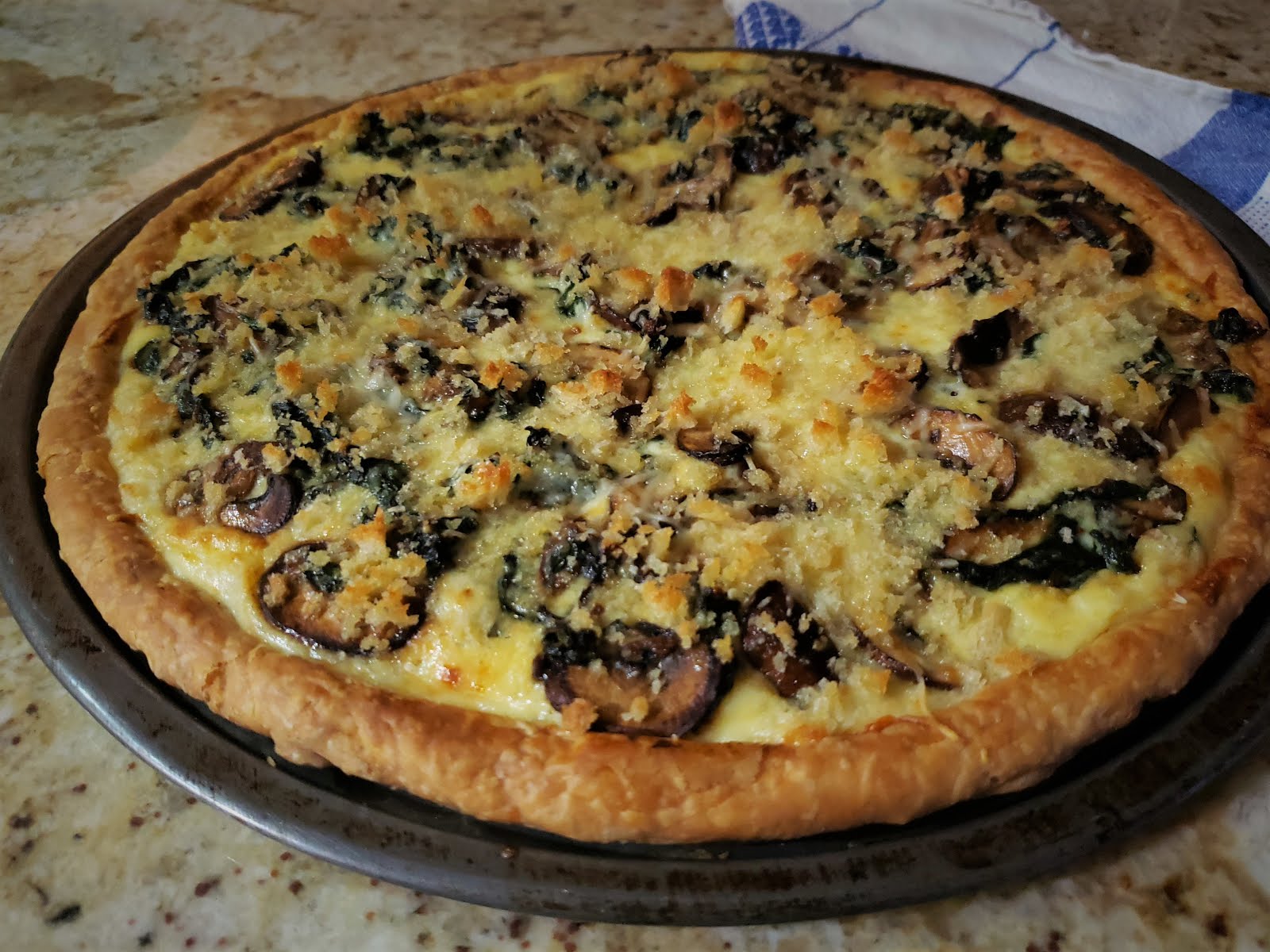
Savory Beet Greens & Mushroom Quiche...two ways...


This spring has been for me a season of beet greens.  It started when I saw some beautiful beets at the store and suddenly realized I hadn’t had beets in a while and that I was really hungry for them.  These particular beets had beautiful tops…so I saved them and added them to a pasta (or perhaps a grain pilaf…the exact preparation escapes me now).  Then suddenly I had a couple private dinners in a row that included roasted beet salads.  So I had more beet greens—because when you buy nice beets you almost always get the greens too…which basically makes them free.  So I made more pastas and pilafs…and a fantastic soup (with pasta) that I hadn’t had in a while… 
 
And still there were more.  So when I came home from a class with a pastry shell left from the demonstration, I decided to make a beet greens tart.  Greens of all kinds make fantastic fillings for tarts, so a tart of nothing but the greens…shrouded in a custard and enhanced with a little onion and garlic…or bacon or sausage…would have been delicious.  But at the time I happened to have some mushrooms on hand.  I remembered a good pasta I made a year or two ago with mushrooms, greens and bread crumbs.  So I decided to turn that pasta into a tart. 


I hadn’t planned on posting the recipe—there are after all, many, many tart recipes on my blog—but this tart was the thing I decided to make again when I ended up with another windfall of beet greens.  Anytime I like something so much that I make it twice in a short span of time, it’s usually a good indication that I should post the recipe—if for no other reason than I know I will be glad I did when at some point down the road I want to make a well-liked dish again and I can’t find my notes.

Aside from selfish reasons, I thought the post would be instructive.  It is the season of greens at the markets…and people are always looking for ways to use this abundance.  This tart is a great way to do this.  Even if you don’t have beet greens:  You can of course replace the beet greens with spinach or chard…even kale (just remember to blanch kale before adding it to the pan with the onions).

The second time I made the tart I didn't really have enough of the beet greens (on the left)...
so I supplemented with a handful of spinach and a few chard leaves... 
Almost any green would be good in this tart.

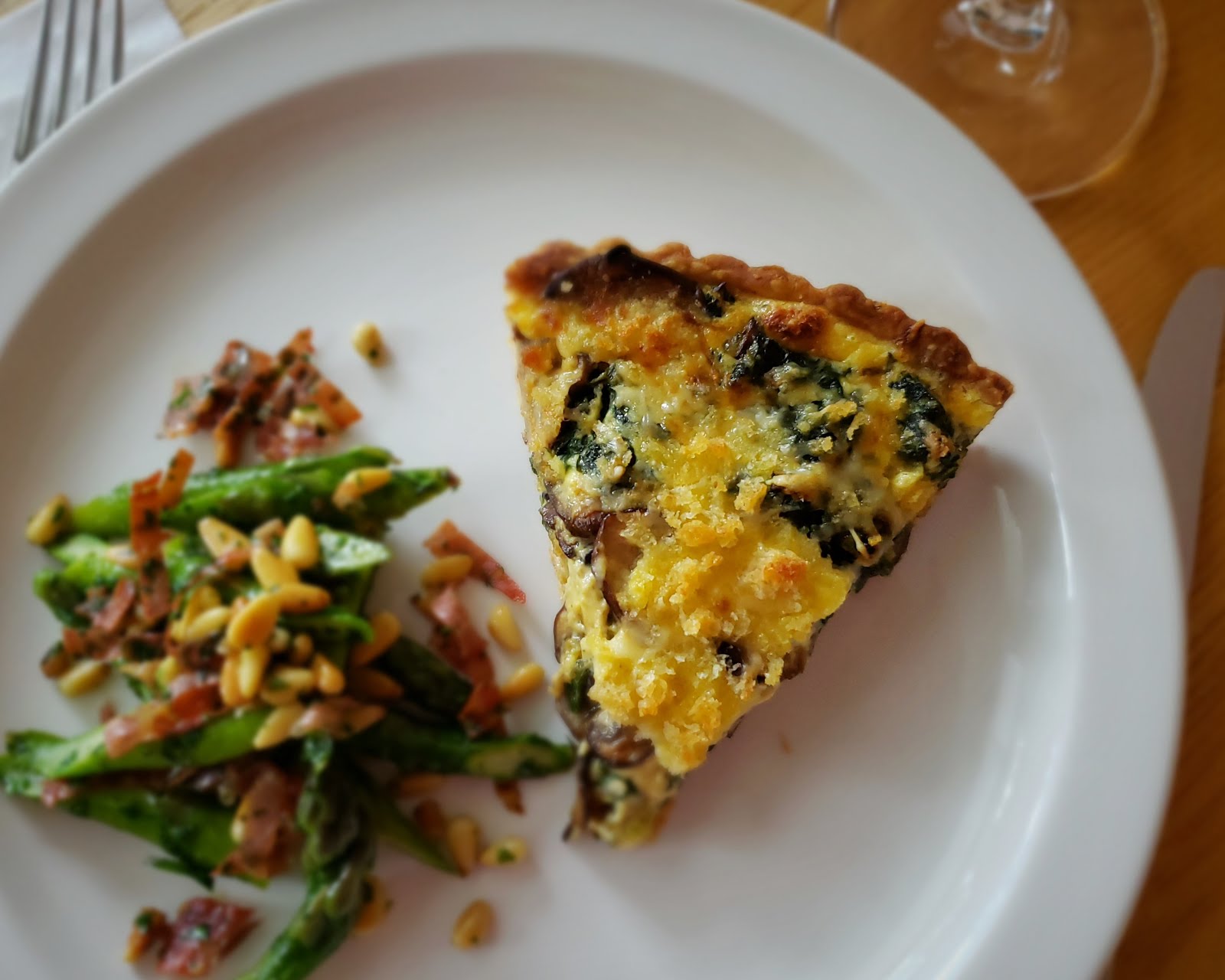
But beyond the tart being a great place to use some of your greens, I had another reason to post this recipe.  The glut of beet greens continued until I had another leftover tart shell from a class—a tart shell that was a different shape.  The first tart shell was the large, almost flat, pizza style that I tend to favor (it shows off ingredients to great advantage...plus, it has a higher proportion of crust to filling…which I love).  The second was a traditional shell (baked in a removable bottom, 9-inch tart pan).  I have always told people that these two shells (the 12-inch pizza pan crust and the 9-inch standard crust) held the same amount of filling…but I think this is hard for most people to believe.  (They certainly don’t look like they would hold the same amount of filling.)  Posting this recipe is my chance to demonstrate that this is in fact true.  Both the tarts pictured in the post used exactly the same amount of vegetable filling and custard.  You can make it either way.  The traditional style will appeal to people who really think tarts are all about the filling.  The “pizza style” will appeal to those who—like me—always want more crust.


Before I close I want to make a couple of observations about the ingredients.  The first time I made the tart I used red onion and mature garlic.  When I made it the second time I had spring onions and green garlic in my pantry…so of course I used those!  You should use what you have on hand.  I have given instructions for both.   

And while on the subject of ingredients, I want to mention the rosemary.  I normally don’t make a big deal about the addition of particular herbs, because I think they fall into the category of seasoning to your preferences.  But for this recipe, if you have it—and you like it—you should include it.  It is delicious with both mushrooms and greens…and it really adds to the savory and complex flavor of this tart.  I’m sure the tart would be good without it…but it is exceptional with it.

Finally, you may have noticed in the title of the post that I have called this recipe a “quiche”…yet I have referred to it as a “tart” throughout the post.  I was going to call it a tart in the title…because it is a tart:  It’s baked in a tart pan…and the filling is cradled in a flaky pastry crust.    But it is also a quiche—a specific class of tarts in which the filling that goes into the crust is suspended in an egg custard.  I bring this up only because I was asked this very question in a class recently:  Was I making a tart? Or a quiche?  And, what exactly is it that makes something a tart or a quiche?  I then realized I had been using the words interchangeably as I taught the class…because the thing I was making happened to be both.  But of course this is not always the case.  As far as I know, all quiches are tarts.  But it is not true that all tarts are quiches since all tarts (savory or sweet filling baked in a pastry crust) don’t necessarily include custard.  So now you know the difference (if you didn’t before…).  In any case, whatever you choose to call it, I hope you will find it to be as satisfying and delicious to eat as I have.  And I also hope you will find it to be a useful way to use and enjoy the greens that are flooding the markets right now.


Beet Greens & Mushroom Quiche

Olive oil
1/2 medium red onion, finely diced, or 2 or 3 spring onions, finely sliced or minced
1 clove garlic, minced, or one stall green garlic, finely sliced or minced
A small sprig of rosemary, picked and minced (to make about 1/2 to 3/4 t. minced)
1/8 t. hot pepper flakes
5 oz. (trimmed weight—no stems or ribs) beet greens, Swiss chard or kale, rinsed in several changes of water
8 oz. crimini mushrooms, sliced 1/4-inch thick
1 12-inch “pizza-style” tart shell or 1 standard 9-inch tart shell, blind baked (see below)
100 gr/3 1/2 oz. Gruyère cheese, finely grated (about a cup)
2 eggs
1 c. heavy cream
1/3 to 1/2 c. coarse, fresh breadcrumbs, tossed with a teaspoon of melted butter
salt & pepper


Film a wide sauté pan set over moderate heat with olive oil. If you using red onions and mature garlic, add the onions along with a pinch of salt and cook, stirring occasionally until the onions are tender and beginning to become golden at the edges. Add the garlic, rosemary and pepper flakes and cook until fragrant. If using spring onions and green garlic, add the onions and garlic to the pan along with a pinch of salt and cook until tender and translucent. Add the pepper flakes and rosemary and cook until fragrant. The red onion base will probably take about 15 minutes…the spring onion base will take less time—perhaps 5 minutes or so. For both kinds of onions, regulate the heat as necessary to allow the mixtures to sizzle gently, reducing the heat if the onions threaten to scorch. If the pan ever looks dry, drizzle in a bit more oil.

When the onions are cooked, add the greens. If using beet greens or chard, add them a handful at a time, turning with tongs to coat them in the fat and expose them to the heat and adding more as they begin to collapse. If the greens were recently washed, there should be enough water clinging to them to create steam and help them cook…if they were washed ahead (or spun dry) you may need to add a few tablespoons of water to the pan. Cover the pan and cook until the greens are tender. Uncover and continue to cook until any liquid has evaporated. Season to taste with salt and pepper and set aside in a warm spot. 

If using kale, bring a large pot of water to a boil. Add the kale and cook until tender (about 7 minutes). Lift the kale out and spread on a baking sheet to cool. When cool enough to handle, squeeze out the excess water. Add the cooked kale to the onion mixture and cook gently for a few minutes to infuse the greens with the flavor of the onions. Set aside.

While the greens cook, sauté the mushrooms: Depending on the size of your pan, you may need to sauté in batches—don't overcrowd the pan. Heat a sauté pan (non-stick, if you have one) over high heat. Add oil to coat the pan (a tablespoon or so), then add the mushrooms. Cook, shaking the pan occasionally, until the mushrooms are browned, tender and any liquid that they have given off has evaporated. If they seem dry at any time as they cook, drizzle in a bit more oil. Transfer the mushrooms to a plate and season with salt & pepper. When the greens are cooked, add the mushrooms to the greens. Set aside.

Preheat the oven to 375°. Place the baked crust on a baking sheet. Scatter about 2/3 of the cheese over the baked crust. Scatter the greens and mushrooms over all. Whisk together the eggs and the cream. Season with salt and pepper—and a pinch of freshly grated nutmeg if you like.

Slowly pour the custard over the vegetables, jiggling the pan a bit so the custard will be evenly distributed and will penetrate the vegetables. Be careful not to let the custard flow over the edge.


If there are any low places in the edge of your crust, you will not be able to use it all. Scatter the remaining cheese over the tart, followed by the buttered breadcrumbs. Bake the tart until the custard is set—about 20 minutes for the pizza-style tart, 25 for the traditional (a knife inserted in the center will come out clean). Slide the tart under the broiler to brown slightly if you like. Serves 6 as an entrée (with a salad or vegetable side), 8 to 10 as a light first course with a fluff of lightly dressed greens.


Pâte Brisée
(Short Crust Pastry)

For a 12- to 13-inch “pizza-style” crust
1 3/4 c. all-purpose flour (200g)
1/2 t. salt
11 T. cold unsalted butter, cut into pieces (150g)
1/4 to 1/3 c. ice water

For a 9- to 10-inch tart shell

1 1/3 c. all-purpose flour (150g)
3/8 t. salt
8 T. cold unsalted butter, cut into pieces (113g)
3 to 4 T. ice water

Combine the flour and the salt in a medium-sized bowl.  Rub the butter into the flour until the butter is in small pea-sized pieces. Drizzle the smaller measure of ice water over the flour/butter mixture.  Using your hands, fluff the mixture until it begins to clump, adding more water if necessary.  Turn the dough out onto a counter and form into a mound.  Using the heel of your hand, gradually push all of the dough away from you in short forward strokes, flattening out the lumps.  Continue until all of the dough is flat.  Using a bench scraper, scrape the dough off the counter, forming it into a single clump as you do.  Form the finished dough into a thick disk.  Chill for at least 30 minutes.

To roll out, let dough warm up for a moment or two.  Butter/spray the a pan and set it aside.  Roll out the dough on a lightly floured surface into a circle that is about 1/8- to 1/6–inch thick and with a diameter 2 to 3 inches larger than that of the pan.  Trim any ragged edges.  Brush off the excess flour and fold the dough circle in half.  Transfer it to the prepared pan.  Unfold the dough and ease it into the pan being careful not to stretch it.  Fold the edges to form a ½-inch rim of a double thickness of dough for the pizza-style crust.  For the traditional tart pan, simply press the dough against the sides of the pan (being sure not to stretch the dough) and cut the dough off flush with the edge of the tart pan.  Chill for at least 30 minutes.

To blind bake, line the pastry with aluminum foil or parchment paper, pressing it into the corners and edges.  Add a layer of pie weights or dried beans.  Bake in a 400° to 425° oven for 20 to 25 minutes.  When the pastry begins to color on the edges and is cooked through, remove the foil and weights and continue baking until the pastry dries out and turns a golden brown (another 5 minutes or so).

Printable Version


Sunday, December 30, 2018

Baked Risotto…with Mushrooms & Spinach


Almost every holiday season I teach a class that includes several recipes for meals that are relatively quick and simple.  The goal is to give cooks a few tools to prepare fresh hot meals for their families in the midst of a season when there isn’t a lot of time to cook.  Not surprisingly, it is a popular class.  I have heard back from several people who have made some of the recipes part of their regular repertoire.  Two of the recipes (Butternut Squash & Black Bean Burritos and Broccoli Cheese Soup)  have already appeared on my blog.  Today—even though the holidays are mostly over—I wanted to share another: Baked Risotto with Mushrooms & Spinach.
 

You may notice that I used the phrase “relatively quick” when I described the recipes in this class.  I always start this particular class with my definition of a “quick” meal.  Not everyone’s definition is the same.  To me, if I can sit down to the table an hour after I walk into the kitchen, that’s quick.  I know that to some people less than 30 minutes is the bar…and there is a place for this kind of speed…but to me this falls more into the realm of warming up leftovers…or throwing together a sandwich or minimal salad.  It isn’t typically the kind of thing I would teach in a class.
 
This baked risotto fits easily into my one hour window.  And you can shorten your time to 45 minutes if you have good knife skills.  Begin by preheating your oven, heating the stock, dicing the onion and mincing the garlic.  As soon as they are cut, start cooking the onion and garlic.  While the onion cooks, slice and sauté the mushrooms.  At this point (after about 15 minutes of work) you will add the rice to the onions


..and then the wine.  When the wine has reduced, add the mushrooms 


and an amount of hot stock equal to twice the volume of your rice.  Salt, stir, cover and transfer to the oven and cook for 10 minutes. 

During this ten minute window prepare the spinach and grate the Parmesan.  If you are using boxed, triple-washed spinach, just remove any large stems and chop very roughly.  If it is truly baby spinach, you probably won’t need to chop it.  If you have unwashed spinach (from the farmer’s market, for example), this will add to your prep time.  In this case, the first thing I do (before I start the onion) is to start washing the spinach.  I trim/strip away any large stems and rinse it in as many changes of water as is necessary to get rid of the grit (check out my post on washing greens if you are unsure of how to do this).  I weave in multiple changes of water and spinning the leaves dry while I’m cooking the onions and mushrooms and grating the cheese.


After ten minutes of cooking, take the risotto out of the oven.  Give it a good stir.  It will have absorbed most of the stock.  If it seems very tight, add enough of the hot stock to loosen it up, remembering that the spinach will release liquid while it cooks.  Add the spinach and stir in.  Taste…season if necessary.  Cover and return to the oven.  At this point you will have ten to fifteen minutes (while the risotto finishes cooking and rests) to set the table…pour wine…start the dishes…or even cook a piece of fish or a chicken cutlet if you want to serve the risotto as a side. 


Check the risotto after eight minutes.  It should be al dente.  If it is still a bit crunchy, return it to the oven for another couple of minutes.  When the risotto is done cooking you will have the opportunity to correct the creaminess and consistency by stirring, and by adding stock, 


butter and Parmesan—just as you would with regular stove top risotto.  Aim for a thick—yet fluid—consistency.  Cover and let the risotto rest for three to five minutes.  Correct the consistency again and serve. 

This method can be easily adapted to other additions.  As with this recipe, you can introduce the additions at any point (beginning—like the mushrooms…middle—like the spinach…or end—herbs, other cooked elements, etc.).  The addition of the liquids will be exactly the same as in this recipe.  Simply start with liquid (stock) equal to twice the volume of rice, adding a bit more half way through and again at the finish.  (You will probably end up using almost three times the volume of liquid as rice.)

The finished risotto will not have quite the creaminess or finesse of a risotto you have tended and cooked in the usual way…but it will be very good.  Better, I would contend, than most of those convenience foods that you would be able to get to the table in less than 30 minutes….


Baked Risotto with Mushrooms & Spinach

3 T. unsalted butter
1 small to medium onion (about 6 oz.), finely diced
2 to 3 cloves garlic, minced
1 1/2 c. Arborio rice
1/2 c. white wine
4 to 4 1/2 c. chicken or vegetable stock, hot
1 T. olive oil, plus more as needed
12 oz. mushrooms (white, crimini, oyster, shiitake, etc.), trimmed as necessary and sliced
5  to 6 oz. cleaned (large or stringy stems pinched off or stripped away) baby spinach, washed, dried and roughly chopped if necessary
2/3 c. finely grated Parmesan (2 oz.)
3 T. unsalted butter


Heat the butter in a 3 1/2-quart (or slightly larger) straight-sided sauté pan or Dutch oven.  Add the onion and garlic and sweat until soft, but not brown—10 minutes or so. 

While the onion cooks, heat another tablespoon of olive oil in a large non-stick sauté pan over medium high heat.  When the pan is hot add the mushrooms and sauté until golden and softened and any liquid they release has been reabsorbed.  If the mushrooms seem dry, add a bit of butter or more olive oil.  (If you don’t have a non-stick sauté pan, use a regular sauté pan and deglaze the pan with a splash of water, wine or stock.  Reduce to a glaze.)  Season with salt and pepper and set aside.

When the onions are nice and soft, add the rice and continue to cook for a minute or two.  Add the wine and cook until the pan is nearly dry.  Add the mushrooms and 3 cups of the hot stock.  Bring to a boil, taste for salt, cover and transfer to a 400° oven.  Bake for 10 minutes.  Remove from the oven and stir well.  Taste and add salt if necessary. If it seems dry, add a splash of the remaining hot stock.  Add the spinach and stir it in.  The pan will seem crowded, but this is OK…the spinach will collapse quickly as it cooks—and it will release more liquid to help moisten the rice.  Cover the pan and return the pan to the oven. 

Continue to bake the risotto until it is tender.  Check after 8 minutes.  It should be al dente…but not crunchy.  If it seems crunchy, return it to the oven for another couple of minutes.  When done remove from the oven and stir.  Add and stir in as much of the remaining broth as you need to obtain a creamy, soft consistency.  Add the remaining butter and the cheese and stir well...again, adding more stock if necessary.  Cover the pan and let rest for 3 to 5 minutes. 

Serve immediately.  Serves 4 generously.  Serves 6 generously as a side dish.

Variation:  This dish is a great way to use leftover roast turkey or chicken.  Add 4 to 6 oz. (about 1 1/2 c.) shredded roast turkey or chicken after the rice comes out of the oven (warm the meat briefly in a bit of stock before adding).